


Cover Crop Options in 2015
Mike Stanyard, Field Crops & IPM Specialist
Northwest New York Dairy, Livestock & Field Crops
August 7, 2015
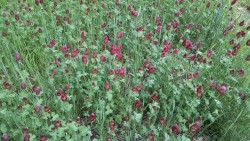
There has been a huge emphasis on soil health, and cover crops are an important piece of this puzzle. There are a lot of options when it comes to choosing a cover crop species (See table). You have to ask yourself, "What do I want to accomplish?" is it soil conservation, increase organic content, a trap crop for nitrogen, comply with conservation payments or weed control? Some other things to consider is cost (See table). Do you want a species that winterkills or overwinters? Is compaction an issue? Do I need some extra forage? We know that there is a benefit to keeping something growing and covering our fields at all times. It looks like there is also a benefit to planting multiple species together. Mixing tap root and fibrous root species together helps create soil microorganism biodiversity.
We know radishes do a great job of loosening up the soil when there is a compaction issue. However, there is some concern that we may not get the nitrogen back that we put into them. Radishes degrade very quickly in the early spring. Is all the nitrogen gone by the time the corn is ready for it? It might be more beneficial to plant an overwintering species like a winter grain or ryegrass with the radish to pick up that N and keep it around longer so the corn can utilize it when it needs it most.
We have seen cover crops planted with many different drills, air flowed, broadcast and aerially applied. All can be successful; however, proper calibration can be tedious and frustrating. Most planters do not have settings for some of these non-traditional plants. Take the time to work it out! You do not want to waste your time by putting on too little and you do not want to waste money by putting on way too much.
Preventative Planting Acres
If a cover crop is being planted following a planned corn or soybean crop, check herbicide labels if a pre-emerge was applied. Some of the small seeded cover species may not be able to be planted due to plant back restrictions. Penn State has a great herbicide reference table for cover crops, http://extension.psu.edu/plants/crops/soil-management/cover-crops/herbicide-persistence/herbicide-carryover-table. The folks at Purdue University have also put out good a reference, "Cover Crops for Prevented Planting Acres," https://ag.purdue.edu/agry/extension/Documents/PreventedPlantingCovers2015.pdf.
Extra Forage
There are a couple of options for the early August planting date. A common choice is spring/forage oats. They are usually in the boot stage by mid-October. I have seen from 1.5 to 2 tons dry matter per acre. You can add annual ryegrass to the mix and field peas or clover if higher protein is desired. Planting winter triticale has become popular after corn silage harvest. It is harvested in May just after flag stage emergence (GS 9). We have seen 2-4 tons of dry matter per acre in NY. See the Winter Triticale Forage factsheet at http://nmsp.cals.cornell.edu/publications/factsheets/factsheet56.pdf for specifics.
Cover Crop Species (pdf; 19KB)
Dairy
Livestock
Grazing
Forages
Grains
Upcoming Events
TENTATIVE- 2026 Dairy Feeder School - November 2026
November 11 - November 12, 2026
Dates are TENTATIVE for 2026! More Details to Come!
Join the Regional Dairy Specialists for a one day on-farm training for dairy farm feeders. The training will be offered in English and Spanish and will feature stations with hands-on activities and demonstrations.
Dairy Winter Webinar Series 2027
January 12, 2027
January 19, 2027
January 26, 2027
February 2, 2027
February 9, 2027
February 16, 2027
February 23, 2027
Register for our free upcoming 2027 dairy winter webinar series: LINK TO COME
TENTATIVE: Dairy Bovine Reproduction and Artificial Insemination Training Course
April 1, 2027
Join us in April 2027 (date to be determined) for a two-day workshop with hands-on training in Bovine Artificial Insemination. Space will be limited, registration link to come!
Announcements
Follow us on Instagram
See photos and reels of our most recent events and programs!Join us on Facebook!
Follow us on Facebook to get up to date posts about events, workshops and everything NWNY!Add us on LinkedIn!
Connect with us on LinkedIn to get more information about upcoming workshops and programs!