


On a Farm Not So Near You: Tillamook, OR
Libby Eiholzer, Bilingual Dairy
Northwest New York Dairy, Livestock & Field Crops
Last Modified: March 19, 2015
On a Farm Not So Near You: Tillamook, OR
During the last week in January my husband and I took a trip to Oregon. As we both work in the dairy industry, it was only fitting that we included a farm tour. We visited Victor Dairy, LLC, a 400-cow grazing dairy near the coast which is a member the Tillamook County Creamery Association, a well-known local cooperative. We made the connection with farm owner Chad Allen through a friend of mine who works for the Oregon State Extension Service.
When we left the farm, my husband, Garrett, commented that dairy farming in Oregon seems to be almost a completely different business than dairy farming in New York. The first thing that jumped out at us was the weather. Allen said that in the Tillamook Valley, temperatures stay between 30 and 70 degrees year round. While they do get a few snowstorms and freezes in the winter, the mostly-open barns show that winter weather isn’t a constant problem for them. As for summer, cows don’t suffer terribly from heat stress, as witnessed by the relatively low number of fans in the barns.
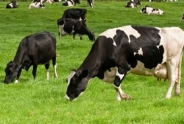
While the cool summers are great for the cows, and the abundant rainfall creates excellent conditions for grazing, these factors make prospects for corn silage pretty dismal. The TMR at Victor Dairy includes flaked corn and barley, cottonseed, wheat distillers, brewer’s malt, alfalfa hay, a protein/vitamin/mineral mix and hay silage in the form of baleage; no bunker silo to be found! Allen shared with us that they used to purchase corn silage by the truckload from the valley on the other side of the mountains, but that the cows never did very well on it, and that the quality deteriorated rapidly within 2-3 days. Now they rely on baleage as the main forage in their TMR. That’s quite hard to imagine coming from a state where growing corn is an integral part of dairy farming. In the summer the primarily Holstein herd spends most of its time grazing, and receives grain in the parlor and TMR in the barns.
Another interesting and radically different aspect of the operation is manure management. All of the farm’s liquid manure is delivered to a digester owned by the Port of Tillamook Bay, and the effluent is trucked back to the farm. The tax credits and federal carbon credits are signed over to the port, and a broker sells those to offset the cost of hauling. Part of the contract also stipulates that no more N and P can be returned to the farm in effluent than were taken away in raw manure. Allen says he has been happy with the program overall, and highlights this benefit: 7-8% of the nitrogen returned to the farm in effluent is in a more readily available form to the plants upon spreading than undigested manure.
I’ll have to admit that the green grass and light rain felt pretty good for a January day, but the mildness of the Oregon winter doesn’t mean that dairy farmers there don’t have any challenges, they’re just different than ours here in New York.
Dairy
Livestock
Grazing
Forages
Grains
Upcoming Events
TENTATIVE- 2026 Dairy Feeder School - November 2026
November 11 - November 12, 2026
Dates are TENTATIVE for 2026! More Details to Come!
Join the Regional Dairy Specialists for a one day on-farm training for dairy farm feeders. The training will be offered in English and Spanish and will feature stations with hands-on activities and demonstrations.
Dairy Winter Webinar Series 2027
January 12, 2027
January 19, 2027
January 26, 2027
February 2, 2027
February 9, 2027
February 16, 2027
February 23, 2027
Register for our free upcoming 2027 dairy winter webinar series: LINK TO COME
2027 Corn Congress

January 13, 2027
Henrietta, NY
Information Coming Soon
Announcements
Follow us on Instagram
See photos and reels of our most recent events and programs!Join us on Facebook!
Follow us on Facebook to get up to date posts about events, workshops and everything NWNY!Add us on LinkedIn!
Connect with us on LinkedIn to get more information about upcoming workshops and programs!