


Cold Weather Calf Challenges - How are You Doing?
Jerry Bertoldo, Dairy
Northwest New York Dairy, Livestock & Field Crops
Last Modified: June 25, 2013
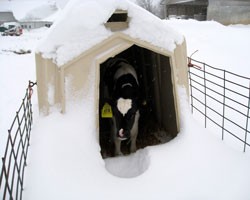
Winter adds stress to those who have to don extra clothing and work in cold temperatures on the farm. We can go home, take a hot shower, get warmed up and enjoy a satisfying meal before we have at it again tomorrow. Our calves don't have it quite so lucky. Think about some of the environment realities these little ones face.
- Just born calves have about 18 hours of stored energy for maintenance when the weather is calm and warm. Wet just-born calves in well below freezing conditions may run out of "gas" in a few hours.
- Calves less than 3 weeks of age need extra energy for keeping warm below 59°F
- Calves older than 3 weeks need extra energy for keeping warm below 42°F
- These threshold temperatures increase with wind and wet conditions
- Energy requirements increase with wind chill, evaporative cooling (wet legs and belly) and hair coat problems (mud, hair loss, matting/spiking from licking) potentially doubling in extreme conditions
- Smaller calves have greater surface to body mass ration and chill easier
- Air movement over a dry calf, less than 3 months old, at a temperature under 50°F in excess of 1 MPH is considered a draft.
- Straw insulates better than shavings
- Calves like to "nest". Straw makes this easier, but needs to be at least 4-6 inches deep.
Calves do not like drafts, but need fresh air. Well bedded hutches facing south do this rather well. Calf barns are generally built to naturally ventilate as well as they can in the summer. When calf barns are closed up in the winter the ammonia generated under the calves from manure and urine is a challenge to clear out. If you can smell it, it is too strong. These levels are irritating to the respiratory tract and can predispose the calf to lung infections.
- Barns with two rows of pens ventilate more evenly than four row types
- Wire paneled pens offer better air mixing than ones with solid sides. Pens with solid back panels can easily lead to poor air quality.
- Early pneumonia (first two weeks of age) may be due to malnutrition (poor immune development), inhalation of milk (sloppy tube feeding, excessively large nipple holes), inhalation of bedding dust or significant BRSV virus exposure from shedding adults in the calving pen.
Resistance to disease in the young calf in the winter is very much influenced by energy balance and protein availability arguably as important as colostral immunity. Failing to address temperature drops, heat-depleting conditions and body size when feeding calves explains why more calves are lost in the cold weather than any other time of year.
- Calves nurse 20-25% of their body weight per day when left on the dam. 8-12% of BW in milk or milk replacer is what we commonly hand feed to dairy calves.
- Twice a day feeding makes high feeding rates difficult due to the inability of the gut to efficiently handle such volumes of liquid feed. Feeding on a 12 and 12 instead of a 14 and 10 hour interval basis helps to a degree. Going to 3X feeding is the better choice.
- Whole milk provides 25% more energy than most milk replacers on a volume basis.
- Calves do not digest starter as well in the first three weeks of life as they do after that. Forcing calves to eat starter early at the expense of milk/replacer intake not only slows growth potential, but is stressful to the calf and biologically counterproductive.
Calves are bovine infants. The characteristic early-to-their-feet toughness belies the susceptibility they have to stress, subpar nutrition and weather extremes.
Dairy
Livestock
Grazing
Forages
Grains
Upcoming Events
2026 Dairy Feeder School- Wyoming County
November 11, 2026
Perry, NY
Registration will open by the end of September.
Wednesday, November 11, 2026
Join the Regional Dairy Specialists for a one day on-farm training for dairy farm feeders. The training will be offered in English and Spanish and will feature stations with hands-on activities and demonstrations.
2026 Dairy Feeder School- Ontario County
November 13, 2026
Clifton Springs, NY
Registration will open by the end of September.
Friday, November 13, 2026
Join the CCE Regional Dairy Specialists for a one day on-farm training for dairy farm feeders. The training will be offered in English and Spanish and will feature stations with hands-on activities and demonstrations.
Dairy Winter Webinar Series 2027
January 12, 2027
January 19, 2027
January 26, 2027
February 2, 2027
February 9, 2027
February 16, 2027
February 23, 2027
Register for our free upcoming 2027 dairy winter webinar series: LINK TO COME
Announcements
Follow us on Instagram
See photos and reels of our most recent events and programs!Join us on Facebook!
Follow us on Facebook to get up to date posts about events, workshops and everything NWNY!Add us on LinkedIn!
Connect with us on LinkedIn to get more information about upcoming workshops and programs!